













Saw a snake in the yard, the garage, or coiled up by the woodpile — and now you’re wondering what it was? This guide covers every snake you’re realistically likely to meet in West Tennessee, from Memphis and Shelby County to Reelfoot Lake and the Tennessee River bottoms, with photos and the field marks that actually separate one species from another.
Here’s the most important fact first: West Tennessee has only four venomous snake species — the copperhead, the cottonmouth, the timber rattlesnake, and the rare western pygmy rattlesnake. Everything else on this page — roughly thirty kinds of snakes — is non-venomous and harmless to people and pets. Most snakes Memphis homeowners call us about turn out to be ratsnakes, watersnakes, or garter snakes: beneficial animals that eat rodents and, in the kingsnakes’ case, other snakes.
Never approach, corner, or handle a snake to identify it. You don’t need to. Take a photo from a safe distance — at least six feet away, zoom in with your phone instead of stepping closer — and compare it to this guide. If a snake is inside your home, in your garage, or won’t leave your yard, don’t try to move it yourself: keep people and pets away and call Apex Wildlife Control at 901-598-8555. Our phones are answered 24/7, and we’re licensed by the Tennessee Wildlife Resources Agency (TWRA Wildlife Control Operator Permit #69).
A note on how to use this guide: no single trait — not head shape, not color, not behavior — identifies a snake by itself. Use the combination of pattern, body shape, habitat, and behavior for each species, and when you’re not certain, treat the snake as venomous and give it room.
Part 1: The Four Venomous Snakes of West Tennessee
All four of West Tennessee’s venomous snakes are pit vipers. Each has a heat-sensing pit on each side of the head between the eye and the nostril, vertical (cat-like) pupils, and a distinctly triangular head that is much wider than the neck. Those features are real — but they’re features you’d have to be uncomfortably close to check. Pattern and habitat, which you can judge from a safe distance, are the safer way to learn these four.

Copperhead — Agkistrodon contortrix
Typical size: 24–36 inches — a medium-sized, heavy-bodied snake.
How to identify it:
- Dark brown hourglass-shaped bands: wide on the sides of the body, pinched narrow across the middle of the back — the single most reliable copperhead mark. Look at the shape from the side, not just from above.
- Body color is light brown, tan, or grayish with a coppery-red, distinctly triangular head.
- The pattern blends almost perfectly into dead leaves — copperheads rely on camouflage and usually hold still rather than flee.
- Vertical pupils and a facial pit (visible only up close — don’t get close enough to check).
- Babies have a bright yellow tail tip, used as a lure to attract frogs and lizards. A small, boldly banded snake with a yellow tail in fall leaf litter is a young copperhead until proven otherwise.
Habitat and behavior: Forested areas, rocky wooded hillsides, and anywhere with logs, rocks, or deep leaf litter for cover — including suburban yards that back up to woods, and edges of wetlands and streams. Southern Copperheads occur in extreme West Tennessee, intergrading with the Northern subspecies. Mostly active at night in summer. Copperheads account for the most venomous snakebites in Tennessee, almost always when someone steps on or reaches near a snake they never saw — the venom is comparatively mild and deaths are extremely rare, but any bite needs an emergency room, not home remedies.
Commonly confused with: Milksnakes (their blotches are wide across the middle of the back, the opposite of the copperhead’s hourglass), red cornsnakes, juvenile cottonmouths (which have a dark band through the eye), and eastern hog-nosed snakes (upturned snout, dramatic bluffing — see Part 2).

Northern Cottonmouth — Agkistrodon piscivorus
Typical size: 30–42 inches — a large, thick, heavy-bodied snake.
How to identify it:
- Dark olive-brown to almost black body; the dark crossbands are obvious on young snakes but fade and may nearly disappear on older adults, which can look almost solid black.
- A broad, dark band runs through the eye and back onto the neck, like a bandit’s mask — copperheads don’t have this.
- When threatened, a cottonmouth typically holds its ground, throws its head back, and gapes its mouth open, showing a bright white interior — the display the snake is named for.
- Swims high in the water, with most of the body riding on the surface like a stick; harmless watersnakes swim with the body mostly submerged.
- Vertical pupils, facial pit, and strongly ridged (keeled) scales give it a rough, dull look — no shine.
Habitat and behavior: Swamps, sloughs, wetlands, drainage ditches, oxbow lakes, and slow rivers across the western part of Tennessee — this is a snake of the Mississippi River floodplain and the wet bottoms. TWRA describes cottonmouths as relatively common in the aquatic habitats of West Tennessee. Despite their reputation, cottonmouths are not aggressive; the famous open-mouth display is a warning meant to make you back off, and it works if you let it. Young cottonmouths are boldly banded with a yellow tail tip and are often confused with copperheads.
Commonly confused with: Every watersnake in Part 2 — especially the common watersnake, Mississippi green watersnake, and diamond-backed watersnake. Watersnakes have round pupils, no facial pit, and usually visible dark bars on the scales along the upper lip. If you’re close enough to check pupils, you’re too close — use the eye band, body shape, and swimming posture instead.

Timber Rattlesnake — Crotalus horridus
Typical size: 36–60 inches — Tennessee’s largest venomous snake, and heavily built.
How to identify it:
- Dark chevron-shaped crossbands (like flattened V’s) on a gray, tan, yellowish, brown, or pinkish-gray body; a rusty-orange stripe often runs down the center of the back.
- The tail is dark — nearly black — right before the rattle, and the rattle itself is unmistakable: a stack of hollow segments that buzzes when the snake feels threatened.
- Large, blocky triangular head, vertical pupils, and a facial pit; scales are strongly keeled and dull, never shiny.
- Generally shy and quick to rely on camouflage; usually rattles before it would ever strike, if it warns at all.
Habitat and behavior: Timber rattlesnakes live statewide but hold on only where human disturbance is low — mature woods, rocky hillsides, and bluff country. In West Tennessee that means the wooded bluffs and river hills along the Tennessee River and the least-developed woods; this is not a subdivision snake, and most Memphis-area homeowners will never see one. Some West Tennessee lowland animals (the "canebrake" form) live in river-bottom woods and cane thickets. Timber rattlesnakes are protected in Tennessee and should simply be left alone wherever they’re found.
Commonly confused with: Gray ratsnakes and other harmless snakes that vibrate their tails in dry leaves — a bluff that sounds rattlesnake-like but comes with no rattle. If there’s no segmented rattle on the tail, it’s not a rattlesnake. Prairie kingsnakes and diamond-backed watersnakes are also mistaken for timbers at a glance.

Western Pygmy Rattlesnake — Sistrurus miliarius streckeri
Typical size: 15–20 inches — Tennessee’s smallest venomous snake, about as long as a man’s forearm.
How to identify it:
- Small and thick-bodied, gray or tan, with dark bar-shaped blotches down the back and one or two rows of smaller dark spots along each side.
- An orangish-brown stripe usually runs down the center of the back between the blotches.
- A wide black stripe runs from the eye down to the corner of the mouth; the top of the head has nine large, flat plates (unusual among our pit vipers).
- The rattle is tiny — it sounds like an angry grasshopper or a faint insect buzz, and most people standing a few feet away won’t hear it at all.
- Young pygmies, like young copperheads and cottonmouths, may have a yellow-tipped tail.
Habitat and behavior: Floodplains, wetlands, and moist fields near water. Here’s the honest truth about this snake in West Tennessee: it is rare, state-listed as Threatened, and found only in a narrow band of habitat along the Tennessee River — from the Land Between the Lakes country south through the river counties, with scattered southern-tier localities. It is essentially absent from the Memphis metro. A Memphis homeowner is very unlikely to ever encounter one — but if you’re fishing or hiking the Tennessee River bottoms and meet a small, thick, blotchy snake with a reddish back stripe, give it the respect due any rattlesnake.
Commonly confused with: Juvenile gray ratsnakes (thinner, blotches shaped differently, no back stripe or rattle), young prairie kingsnakes, and juvenile racers. The combination of thick body + back blotches + stripe down the spine + eye stripe separates the pygmy.
Part 2: The Non-Venomous Snakes of West Tennessee
Everything below is harmless to people and pets. Many of these snakes will bite if grabbed — any bite that breaks the skin should be washed and watched like any puncture — but none has venom that matters medically, and all of them are doing free pest control. (Two tiny exceptions to note honestly: the southeastern crowned snake has a mild venom for subduing centipedes and the hog-nosed snake has a mildly toxic saliva for toads — neither is dangerous to people.) Tennessee law protects all of our native snakes as nongame wildlife, so the right move with every snake on this list is to leave it be or call a licensed operator to move it.

Gray Ratsnake (Central Ratsnake) — Pantherophis alleghaniensis
Typical size: 42–72 inches — one of our longest snakes; the snake most Memphis homeowners actually meet.
- Adults are dark gray to black above with a white chin and throat; faint traces of dark blotches often show through on the skin between the scales, especially right after a meal.
- Juveniles look completely different: pale gray with bold dark blotches — and they’re the young snakes most often misidentified as rattlesnakes or copperheads. A juvenile’s blotches are wide on the back, it has round pupils, and there is no rattle.
- A powerful climber: ratsnakes scale trees, brick walls, and barn rafters, and regularly turn up in attics, garages, and chicken coops.
- When cornered, a ratsnake may freeze in a wavy "kinked" posture, musk, vibrate its tail, or bite repeatedly — all bluff.
- Habitat: everywhere — woods, farms, suburbs, and buildings. Confused with: black racer (slimmer, faster, rarely climbs into attics), timber rattlesnake (juveniles), copperhead (juveniles).

Red Cornsnake — Pantherophis guttatus
Typical size: 24–48 inches in Tennessee.
- Orange to reddish-brown with large red blotches outlined in black down the back; the belly is a bold black-and-white checkerboard.
- Blotches are widest across the middle of the back — the mirror image of the copperhead’s hourglass.
- A calm, slender ratsnake relative of woods, fields, and farm buildings; documented across the southern half of West Tennessee.
- Confused with: copperhead — compare the blotches (wide on top = cornsnake; narrow on top, wide on the sides = copperhead) and remember the cornsnake has no triangular head or facial pit.

North American Racer — Coluber constrictor
Typical size: 34–77 inches, but slim — fast, not heavy.
- Adults are uniform dull black or blue-gray above with a clean white chin and a smooth, almost silky look.
- Juveniles are gray with dark back blotches and reddish-brown side spots; the pattern fades as the snake grows.
- An active daytime hunter of open ground — fields, pastures, and field edges — that often raises its head periscope-style to look around and simply outruns trouble.
- In most of West Tennessee this is the Southern Black Racer; in Shelby and Fayette counties the Black-masked Racer occurs, with a dark mask through the eye and a bluish cast.
- Confused with: gray ratsnake (racer is thinner, faster, and almost never in your attic) and juvenile-patterned young are mistaken for pygmy rattlesnakes.

Eastern Coachwhip — Coluber flagellum — RARE
Typical size: 42–60+ inches and pencil-thin for its length.
- Looks like a braided whip: dark brown or black on the front half, fading to pale tan toward the tail.
- Huge eyes, alert expression, and famously fast; holds its head high when moving through open ground.
- Honest status: in Tennessee the coachwhip is known only from three counties in the southwestern corner of the state, in dry, open habitats — a genuine West Tennessee snake, but a rare and local one that most residents will never see.

Rough Greensnake — Opheodrys aestivus
Typical size: 22–32 inches, very slender.
- Unmistakable: bright leaf-green above, yellow-green belly, with rough (keeled) scales and a long, tapering tail.
- Lives in shrubs, vines, and low branches near water and woods edges, hunting insects and spiders; freezes and sways like a twig when approached.
- Completely harmless and gentle. If it’s bright green and in a bush, this is it — nothing venomous in West Tennessee is green.
Eastern Wormsnake — Carphophis amoenus
Typical size: 7½–14½ inches — one of our smallest snakes.
- Smooth, glossy brown or blackish above with a pink belly, the pink wrapping slightly up the sides; the tail ends in a tiny blunt spine.
- Lives under logs, stones, and leaf litter, eating earthworms; the form in West Tennessee is the Midwestern Wormsnake.
- Almost never seen unless you’re turning over yard debris. Harmless and too small to bite effectively even if it tried.
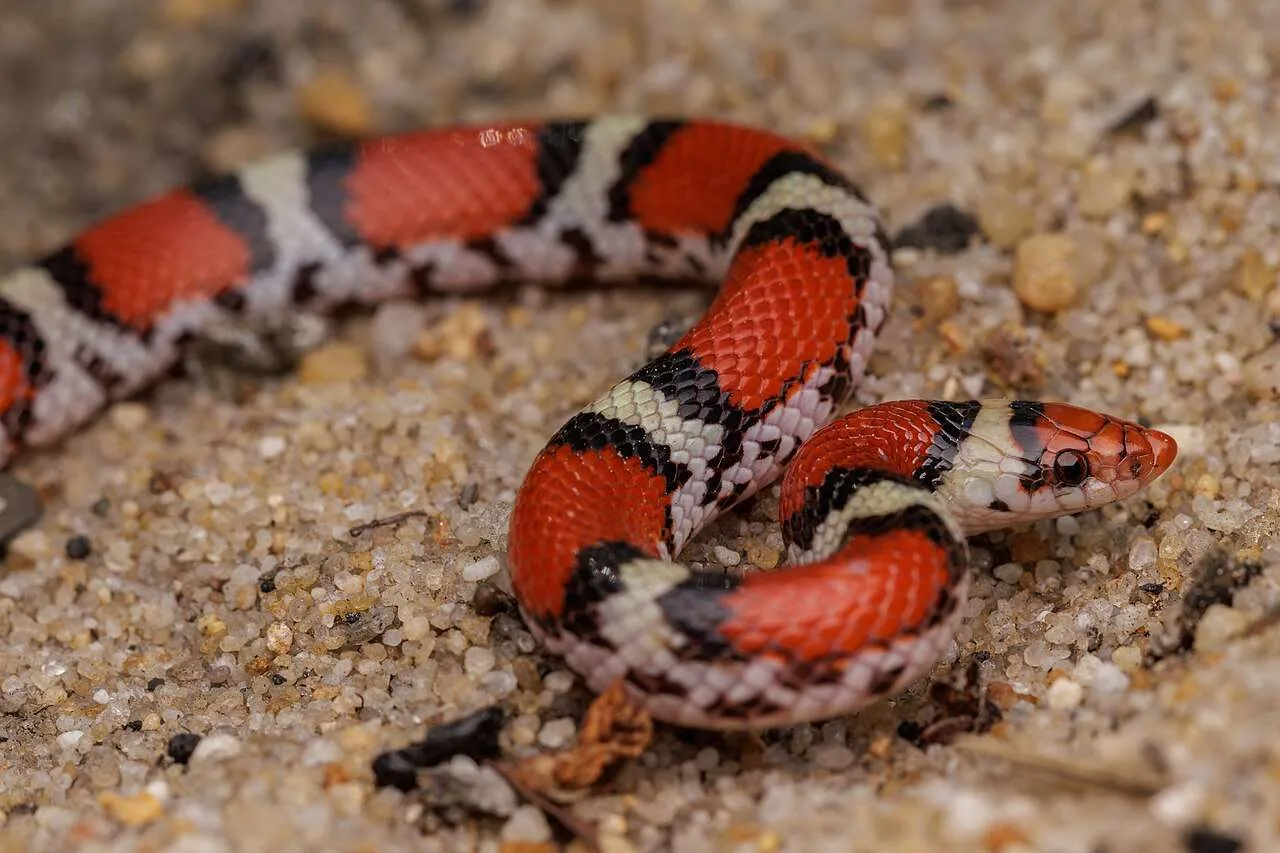
Northern Scarletsnake — Cemophora coccinea copei
Typical size: 14–20 inches.
- Red bands or blotches bordered in black on a white-to-yellowish background — and the key mark: the belly is plain white and unmarked, and the red pattern does not cross it.
- A secretive, nocturnal burrower in sandy or loose soils that specializes in eating reptile eggs; records are scattered and sparse across West Tennessee.
- Confused with: milksnake (whose pattern crosses onto a checkered belly) and the scarlet kingsnake. There are no coral snakes in Tennessee, so no West Tennessee snake with red bands is dangerous.

Ring-necked Snake — Diadophis punctatus
Typical size: 10–15 inches.
- Smooth slate-gray, olive, or near-black above, with a complete yellow-to-orange ring around the neck and a bright yellow-orange belly.
- The West Tennessee (Mississippi Ring-necked) form usually has a row of dark spots down the center of the belly.
- Hides under logs, rocks, and mulch eating worms and small salamanders; when exposed it may coil its tail to flash the bright underside. Utterly harmless — a backyard favorite.

Red-bellied Mudsnake — Farancia abacura
Typical size: 40–54 inches in Tennessee — a big, heavy, secretive swamp snake. The western subspecies (F. a. reinwardtii) is the one found here, often called the Western Mudsnake.
- Glossy, iridescent blue-black above; the belly is pink to red, with the color extending up the lower sides in triangular bars; the chin is yellowish with dark speckles.
- The tail ends in a blunt spine, used to pin down the giant salamanders (amphiumas) it eats.
- Lives in the swamps, sloughs, and slow wetlands around Reelfoot Lake and along streams flowing to the Mississippi River; almost entirely nocturnal and seldom seen.
- This is the snake behind the old "hoop snake" tales — no, it does not roll like a hoop or sting with its tail. It’s harmless.

Eastern Hog-nosed Snake — Heterodon platirhinos
Typical size: 20–33 inches, stout-bodied.
- The giveaway is the sharply upturned snout, like a tiny pig’s nose, used for digging in sandy soil after toads.
- Color varies wildly: yellow, orange, brown, or gray with dark blotches — or plain dusty black.
- The greatest actor in the snake world: threatened, it hisses loudly, flattens its neck like a cobra, and strikes with its mouth closed; if that fails, it rolls onto its back, opens its mouth, hangs out its tongue, and plays dead — flip it right-side up and it will flip itself back over, because a dead snake wouldn’t lie belly-up, obviously.
- Confused with: copperheads and cottonmouths constantly, thanks to the bluff display. The upturned snout and the theater give it away. Harmless to people (its mild saliva is a toad-hunting tool).

Prairie Kingsnake — Lampropeltis calligaster
Typical size: 30–42 inches.
- Smooth and glossy: light brown or gray with darker brown blotches edged in black down the back (the pattern often fades in older snakes), and a plain, unmarked pale-yellow belly — TWRA calls this species the Yellow-bellied Kingsnake.
- A snake of fields, pastures, prairies, and farm edges across the western third of Tennessee.
- Eats rodents and other snakes. Calm and beneficial. Confused with: the mole kingsnake — which, despite often appearing on Tennessee lists, the state atlas shows only in East and southern Middle Tennessee, not West Tennessee; blotched kingsnakes here are prairies. Also confused with juvenile ratsnakes and, at a glance, the pygmy rattlesnake (no rattle, no eye stripe, much bigger).
Speckled Kingsnake / Black Kingsnake — Lampropeltis holbrooki / Lampropeltis nigra
Typical size: 36–48 inches.
- Black with white or yellow speckles — in the Mississippi River counties, including the Memphis area, most scales carry a light spot, giving a salt-and-pepper or chain-like pattern; farther east the same kingsnake complex is nearly solid black (authorities split these as the Speckled Kingsnake, L. holbrooki, and Black Kingsnake, L. nigra, which intergrade here; TWRA lists them together as the Common Kingsnake).
- Belly is yellow with black checker marks.
- Famous for a reason: kingsnakes are immune to pit-viper venom and eat copperheads and rattlesnakes, along with rodents. The best snake a West Tennessee homeowner can have in the yard.
- Habitat: woods, fields, creek bottoms, and suburban edges — anywhere there’s prey.
Milksnake — Lampropeltis triangulum
Typical size: 24–36 inches; the West Tennessee form is the Red Milksnake.
- Smooth, shiny scales; red to reddish-brown blotches with black borders on a pale gray or tan background — the blotches are widest across the middle of the back.
- Belly is a clean black-and-white checkerboard.
- Found around barns, old foundations, rocky woods, and debris piles, hunting mice — the old tale that they milk cows is pure folklore.
- Uncommon in West Tennessee, where records concentrate eastward, but genuinely present.
- Confused with: copperhead — the classic mix-up. Remember: milksnake blotches are wide on top; a copperhead’s hourglass is narrow on top and wide on the sides. Milksnakes also lack the triangular head and facial pit.
Mississippi Green Watersnake — Nerodia cyclopion
Typical size: 30–55 inches — a large, heavy watersnake.
- Dark green, olive, or brown with a pattern so faint it’s often invisible; strongly keeled scales give a rough look; eyes set high on the head.
- West Tennessee only, and barely: known from just three counties in the extreme west, in the Mississippi River floodplain — swamps, sloughs, and oxbows, including Reelfoot Lake.
- Confused with: cottonmouth — the watersnake has round pupils, no facial pit, and dark bars on the lip scales, and it typically flees to the water rather than holding its ground with an open mouth.

Plain-bellied Watersnake — Nerodia erythrogaster
Typical size: 30–62 inches — big, thick, and plain.
- Adults are patternless olive, brown, or gray above with a plain, unmarked yellow belly (the West Tennessee form is the Yellow-bellied Watersnake).
- Juveniles are boldly banded and blotched — and get mistaken for cottonmouths and copperheads constantly. The pattern fades completely with age.
- Famous for wandering far from water, turning up in yards, garages, and crawl spaces well away from any pond.
- Confused with: cottonmouth (adults) — check the plain yellow belly, round pupils, and lip bars; and with the black racer/ratsnake at a distance.
Broad-banded Watersnake — Nerodia fasciata confluens
Typical size: 20–42 inches.
- Broad, dark brown-to-black bands separated by narrower olive, yellowish, or reddish ground color — like dark saddles laid over the whole body, including the sides.
- A Mississippi River counties snake: swamps, sloughs, marshes, and ditches, and especially common around Reelfoot Lake.
- Confused with: cottonmouth — but the cottonmouth’s dark markings are jagged crossbands widest on the belly side with a dark eye mask; the broad-banded’s clean, wide bands, round pupils, and lip bars mark it as a harmless watersnake.

Diamond-backed Watersnake — Nerodia rhombifer
Typical size: 30–63 inches — our largest watersnake.
- Brown or tan with a dark chain-link pattern: crossbands connected by diagonal bars, forming a chain or net of diamonds down the back.
- Rough, heavily keeled scales and a heavy body make it look formidable; it’s a fish-eater of rivers, lakes, reservoirs, and sloughs in both the Mississippi and Tennessee River drainages of West Tennessee.
- Confused with: rattlesnakes (because of the name and pattern — it has no rattle) and cottonmouths. Round pupils, lip bars, no pit, no rattle.

Common Watersnake — Nerodia sipedon
Typical size: 24–55 inches. (The form across most of West Tennessee is the Midland Watersnake, N. s. pleuralis.)
- Brown, gray, or reddish with dark bands on the front half of the body that break up into separate blotches toward the tail; older snakes darken and the pattern can nearly vanish.
- Belly is yellowish with dark, half-moon-shaped marks. Eyes are round-pupiled, and there are dark bars on the lip scales.
- Lives in virtually every creek, pond, lake, and river in West Tennessee — this is the snake in most "cottonmouth in the pond!" calls, and it isn’t one.
- Quick cottonmouth check: watersnakes swim with the body mostly under the surface; cottonmouths ride high on it. Watersnakes flee; they also flatten their heads when cornered, which is a bluff — see the warning box below.
DeKay’s Brownsnake — Storeria dekayi
Typical size: 9–13 inches — a tiny garden snake (the West Tennessee form is the Midland Brownsnake).
- Light brown or gray with a pale stripe down the back bordered by two rows of small dark spots, a dark blotch behind each eye, and dark marks on the lip scales.
- Lives in gardens, mulch beds, and leaf litter eating slugs, snails, and earthworms; females give birth to live young in late summer.
- Confused with: baby copperheads. A DeKay’s is no thicker than a pencil, has spots instead of hourglass bands, a round pupil, and a head barely wider than its neck. This little slug-eater is a gardener’s friend.
Red-bellied Snake — Storeria occipitomaculata
Typical size: 8–16 inches.
- Plain brown, gray, or nearly black above — the belly is brilliant red; there are three pale spots on the neck just behind the head.
- A secretive snake of woods and leaf litter that eats slugs; scattered records across Tennessee, including the west.
- Confused with: the ring-necked snake, which has a neck ring and a yellow-orange (not red) belly.
Rough Earthsnake — Haldea striatula
Typical size: 7–10 inches.
- Plain brown to gray-brown, unpatterned, with rough, strongly keeled scales and usually a faint pale patch on the side of the head.
- A snake of lawns, gardens, and mulch that eats earthworms.
- In Tennessee it’s found only in a few counties in the southwestern corner — most state records come from the Memphis metro — so this is genuinely one of "our" snakes, even if you’ve never noticed one.
Smooth Earthsnake — Virginia valeriae
Typical size: 7–10 inches.
- Plain gray-brown to yellowish-brown, unpatterned, with a cream belly and smooth or only weakly keeled scales — the subtle difference from the rough earthsnake.
- Lives under leaf litter, logs, and garden debris eating earthworms; the western subspecies (V. v. elegans) is the form found in West Tennessee.
- Gentle to the point of almost never biting. Like the rough earthsnake, it’s one of the most common snakes in Memphis yards — and one of the least seen.
Southeastern Crowned Snake — Tantilla coronata
Typical size: 8–13 inches.
- Glossy tan to brown body with a black head and a black collar just behind it, like a tiny hood; the belly is plain pinkish-white.
- Nocturnal and secretive, hunting centipedes under leaf litter and loose soil; records are scattered statewide with much of West Tennessee thinly documented — it’s here, but you’ll seldom see one.
- Full disclosure: crowned snakes have a mild venom used on centipedes and enlarged rear teeth to deliver it. It is not dangerous to people or pets, and the snake is too small and shy to matter — it belongs on the harmless list for any practical purpose.
Western Ribbonsnake — Thamnophis proximus
Typical size: 20–30 inches, slim and elegant.
- Three crisp, clean stripes — including an orange stripe down the middle of the back — on a dark olive-brown body, with a bright white spot in front of each eye.
- The stripes are sharp-edged with no dark spots between them, unlike the gartersnake’s.
- A waterside snake of wetlands and pond edges; in Tennessee, records come from only four counties in the western part of the state — uncommon here.

Eastern Ribbonsnake — Thamnophis sauritus
Typical size: 18–26 inches.
- Three clean yellow stripes on a dark brown or black body, a white crescent in front of the eye, and a distinctive brown stripe along the edge of the belly scales.
- Semi-aquatic: marshes, pond edges, and creek banks throughout most of West Tennessee, where it’s often seen draped in low shrubs overhanging the water.
- Confused with: the gartersnake — ribbonsnakes have cleaner stripes, the white eye-spot, and that brown belly-edge stripe; gartersnakes have dark spots between their stripes.

Common Gartersnake — Thamnophis sirtalis
Typical size: 18–26 inches.
- The classic striped yard snake: three yellowish stripes down a brown, olive, or black body, with two rows of dark squarish spots between the stripes.
- The most widely distributed snake in Tennessee — gardens, yards, parks, and pond edges everywhere, hunting frogs, toads, worms, and minnows.
- Will musk and bite if picked up, but it’s harmless; your garden is better with one in it.
Kirtland’s Snake — Clonophis kirtlandii — EXTREMELY RARE
Typical size: 12–18 inches.
- Grayish-brown with four rows of dark blotches — a double row of large black spots down the back plus smaller spots along the sides — and a brick-red belly with a row of black spots along each edge.
- A wet-prairie and marsh snake that shelters in crayfish burrows and eats earthworms and slugs.
- Honest status: in all of Tennessee, Kirtland’s snake is known from just two localities — one each in Henry and Carroll counties in the northwestern part of West Tennessee, near the Kentucky line. It’s state-listed as Threatened and protected, declining across its whole range. You will almost certainly never see one; if you somehow do, photograph it from a distance, leave it alone, and know you’ve seen one of Tennessee’s rarest animals.
⚠ Venomous Look-Alikes: The Mistakes That Matter
Most dangerous-snake panic in West Tennessee is a case of mistaken identity. These five traps cause nearly all of it:
Watersnake or cottonmouth? This is the big one. Harmless watersnakes are heavy-bodied, rough-scaled, and live exactly where cottonmouths live — and when cornered, a watersnake flattens its head into a triangle and strikes repeatedly, doing a convincing cottonmouth impression. From a safe distance, look for: a dark band through the eye (cottonmouth yes, watersnake no), dark vertical bars on the lip scales (watersnake yes, cottonmouth no), and swimming posture (cottonmouth rides high on the water; a watersnake’s body rides mostly below it). If you can’t see those clearly, back away and treat it as a cottonmouth.
Ratsnake or rattlesnake? Many harmless snakes — ratsnakes especially — vibrate their tails when threatened, and a tail buzzing in dry leaves or against a cardboard box sounds eerily like a rattle. The difference is absolute: a rattlesnake has a segmented rattle you can see. No rattle, no rattlesnake — no matter what the sound suggests.
The hog-nosed snake’s bluff. A snake that hisses, spreads its neck like a cobra, and then dramatically plays dead is an eastern hog-nosed snake — harmless, and committed to the bit. Its upturned snout is the giveaway. Enjoy the show from a few feet away.
Baby copperheads really do have yellow tails. In late summer and fall, tiny boldly banded snakes (8–10 inches) with a sulfur-yellow tail tip are young copperheads, using that tail as a fishing lure for frogs. Young cottonmouths and young pygmy rattlesnakes can show the same yellow tip. Small does not mean harmless — a baby pit viper is venomous from birth. Give babies the same distance as adults.
Head shape alone is unreliable. Yes, our pit vipers have triangular heads — but so does every watersnake that flattens its head in defense, and a copperhead seen from directly above or at rest can look deceptively narrow-headed. Pupil shape is worse: you’d have to be within striking range to see it. Never use one trait. Pattern, habitat, and behavior together — from six feet away or more — are how a snake gets identified.
Found a Snake in the House or Yard? Do This.
- Stop and back up. Give the snake at least six feet. A snake that isn’t cornered almost always leaves on its own.
- Keep kids and pets inside until the snake has moved on or been removed. Most pet bites happen when a dog pesters a snake that would rather leave.
- Watch it from a safe spot (or note where it went). Knowing where the snake is — and being able to describe or photograph it from a distance — makes removal fast and safe.
- Don’t try to move it with a shovel, pin it with a broom, or kill it. Most bites happen during exactly that. Native snakes are also protected nongame wildlife in Tennessee — killing one can be illegal as well as dangerous.
- Call Apex Wildlife Control at 901-598-8555. Our phones are answered 24/7. As TWRA-permitted wildlife control operators (Permit #69), we remove snakes from homes, garages, and yards across Greater Memphis, and — just as important — we’ll find and seal the entry points and remove the food and cover that attracted it, so you don’t meet its cousin next month.
- If someone is bitten: treat every unidentified bite as an emergency. Call 911 or get to an emergency room (pets go to an emergency vet). No tourniquets, no suction, no ice, no cutting — those do harm, not good. Keep the bitten limb still and lower than the heart, and leave the snake alone; a photo from a distance is all the identification help the hospital needs.
Outdoors and left alone, West Tennessee’s snakes are rodent control that works for free — and a kingsnake in the woodpile is actively standing guard against the copperheads. The goal isn’t a yard with no snakes. It’s knowing which ones you’re looking at.
Questions about a snake you’ve seen? Send us the photo — we’re glad to identify it. 901-598-8555.
Found a Snake? We’re Here 24/7
Call Apex Wildlife Control for fast, safe snake removal anywhere in Greater Memphis.